Preloaded Interlocking Metasurfaces
Description:
Technology Summary
Preloaded Interlocking Metasurfaces (PIMs) are a new class of high performance mechanical joints that store internal preload during assembly, dramatically increasing strength, stiffness, and energy absorption. Unlike traditional interlocking metasurfaces, PIMs use a built-in over-center mechanism to lock components into a prestressed state, delivering 3.4× higher tensile capacity and 7.6× greater strain-energy absorption.
PIMs can also be patterned directly into sheet metal to prestress parts before welding, counteracting harmful residual stresses that normally cause distortion, cracking, and reduced fatigue life. This enables faster, cleaner, and more reliable fabrication without heavy fixturing or post weld heat treatment.
PIMs assemble without bolts, rivets, or adhesives and can be manufactured using standard industrial processes such as laser cutting, waterjet cutting, or additive manufacturing.
Key Advantages
- HighStrength Mechanical Joining – Preload boosts tensile strength and stiffness far beyond conventional ILMs.
- Residual Stress Mitigation – Tailored prestress reduces weld distortion and fatigue critical stress concentrations.
- HardwareFree Assembly – No fasteners, adhesives, or complex jigs required.
- Scalable & Material Agnostic – Works with metals, polymers, ceramics, and mixed material systems.
- Lightweight & Reversible – Strong, modular, and easy to assemble or disassemble.
Applicable Industries
- Automotive & EV Manufacturing – Distortion-free body panels, mixed material joints, battery enclosures.
- Aerospace & Defense – Lightweight structural interfaces, vibration-damping joints, fatigue-resistant assemblies.
- Shipbuilding & Heavy Fabrication – Residual-stress control for large welded structures.
- Robotics & Automation – High-stiffness, reconfigurable joints for modular systems.
- Additive Manufacturing – Joining large printed components and improving tolerance robustness.
IP
Patent application filed.
Graphical Illustration
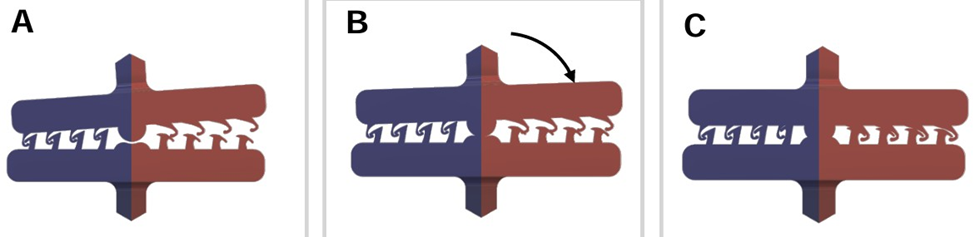
Figure: Assembly of the PIM involves three steps: (A) sliding the left hooks to establish a fulcrum, (B) applying a moment to engage the right hooks and generate preload, and (C) forming a locked, preloaded joint resistant to reopening.
Patent Information:
| Title |
App Type |
Country |
Serial No. |
Patent No. |
File Date |
Issued Date |
Expire Date |
Patent Status |
|
|
|
Inventors:
Keywords:
|