14-151 A Method for Creating Self-Refining Games using Player Analytics
Abstract
Data-driven simulation demands good training data drawn from a vast space of possible simulations. While fully sampling these large spaces is infeasible, in practical applications, such as gameplay, users explore only a vanishingly small subset of the dynamical state space. By concentrating precomputation around these frequently encountered states, computational resources can be allocated more efficiently. Rather than precomputing and storing data for all possible states, which can be resource-intensive and time-consuming, focus will be on the states that have a higher probability of being encountered. This targeted precomputation approach reduces the computational burden and optimizes resource utilization.
Benefit
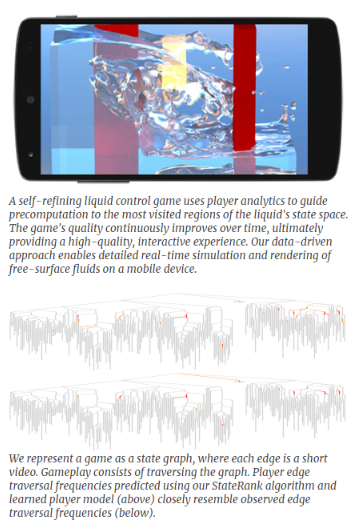
This method is a sampling approach that takes advantage of this observation by concentrating precomputation around the states that users are most likely to encounter. This technique is demonstrated in a prototype self-refining game whose dynamics improve with play, ultimately providing realistically rendered, rich fluid dynamics in real time on a mobile device. This analytics-driven training approach yields lower model error and fewer visual artifacts than a heuristic training strategy.
Market Application
Virtual Reality (VR) and Augmented Reality (AR): In VR and AR applications, analyzing sample user data can help identify the most common interactions, environments, or objects that users are likely to encounter. This information can be utilized to precompute and optimize rendering, physics simulations, or audio processing, focusing computational resources on the elements that contribute most to the user's experience.*
E-commerce and Recommendation Systems: Sample user data in e-commerce platforms can provide insights into popular products, frequently visited pages, or typical user navigation patterns. By concentrating precomputation around these likely user states, such as generating personalized recommendations or preloading relevant product information, the system can enhance browsing and shopping experiences, improving conversion rates and customer satisfaction.*
Social Media Feeds: Social media platforms analyze user behavior and engagement patterns to optimize the content displayed in users' feeds. By leveraging sample user data, precomputation can be focused on the types of content, posts, or interactions that are most likely to resonate with each individual user. This helps create personalized and engaging feeds, improving user satisfaction and platform usage.*
Video Streaming Services: Sample user data can be used in video streaming services to concentrate precomputation on the most frequently accessed videos, genres, or playback scenarios. By analyzing user viewing habits, the system can optimize video transcoding, buffering, or adaptive streaming algorithms, ensuring a seamless and high-quality viewing experience for popular content.*
Navigation and Mapping Applications: In navigation systems and mapping applications, analyzing sample user data can provide insights into commonly visited locations, popular routes, or preferred points of interest. By concentrating precomputation around these likely user states, such as caching map data or optimizing route calculations, the system can improve responsiveness, reduce latency, and enhance the overall navigation experience.*
Other Information
*some aspects of this description were generated using ChatGTP and modified to fit the objectives of the description.
Publications
http://graphics.cs.cmu.edu/projects/self-refining-games/
http://graphics.cs.cmu.edu/projects/self-refining-games/stanton2014_self_refining_games.pdf
https://youtu.be/ZJ9rtG4GTsk
Images